Patrick Starck, Managing Director of HP France and Vice President and General Manager Technology Solutions Group, has made the decision to leave HP and pursue another career opportunity.
Johan Deschuyffeleer will serve as the Managing Director of HP France and Vice President and General Manager of the Technology Solutions Group, on an interim basis, effective immediately. Since 2004, Johan has been Vice President of Go-To-Market Strategy and Sales Productivity, leading the company-wide effort to improve value sales effectiveness and enable value and volume sales success in every market, region and country where HP does business. Prior to that, Johan served as Vice President and Country General Manager for HP Belgium, where he played a leading role in building and maintaining customer loyalty and trust throughout the HP/Compaq merger. While serving earlier as Managing Director for the Belgium-Luxembourg region, Johan succeeded in transforming the company into one of the main suppliers of IT infrastructure solutions in these two countries.
Johan holds a degree in Industrial Engineering from IHRB University in Brussels. He also earned a Master's Degree in Management from IMD International in Lausanne followed by further qualification from the Vlerick School.
vendredi 24 mars 2006

mardi 21 février 2006
What about Carly ?
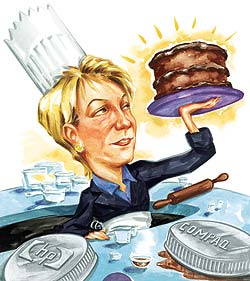 One year after HP ouster, Carly Fiorina has a new life CIRCLING THE GLOBE FOR $50,000-PLUS SPEECHES
San Jose Mercury News / Feb. 9, 2006
By Nicole C. Wong
Toppled from her perch as one of Silicon Valley's most powerful women one year ago, Carly Fiorina has put together a new life that retains some of the trappings, if not the influence, of an elite corporate insider. Since Hewlett-Packard's board showed her the door, the ousted chief executive has been crisscrossing the globe -- and commanding big bucks -- speaking about how to be a good leader. In lots of little ways, Fiorina's past year has been about trading places. Her glory may be fading on the West Coast, but rising on the East Coast. HP removed her portrait from the lobby of its Palo Alto headquarters. But the University of Maryland -- where Fiorina earned her MBA -- hung one up in its Alumni Hall of Fame.While she and her husband still own a Tudor-style mansion on a 2.63-acre lot in Los Altos Hills, they bought a Georgetown condo in Washington, DC, for $3.6 million in May. And instead of leading Silicon Valley's legendary hardware company from the chief executive's seat, Fiorina is serving on the board of directors of two Washington-area companies: Cybertrust, a privately held information security firm, and Steve Case's Revolution Health, a venture that funds companies offering more choice in customer health care services.Slowly, she's been admitting some mistakes she made while at the helm of HP. But not many. And she remains resolute in her public speeches that the biggest and most bitterly fought decision of her HP tenure -- to merge the company with Compaq Computer -- has proved a success.
``I would do the merger all over again,'' Fiorina told more than 600 people who packed a Los Angeles ballroom to hear her October keynote address at the Internet Telephony Conference and Expo. ``I think the merger has been a resounding success.''As Fiorina, 51, has traveled the international corporate speaker circuit since she left HP, she's kept a low profile and shunned media attention. Her spokeswoman kept a reporter away this week, saying Fiorina is busy writing a candid book about her career, due out in September, and is about to travel abroad for two weeks.Speculation was once rife that she would take a high-profile government or public-service post. For a while she was rumored to be a candidate to head the World Bank, but that job went to someone else. Since then she's settled into the life of a former corporate executive in demand for convention keynotes.Her comments surface sporadically from reports around the world of her occasionally frank speeches.After giving an October keynote in Singapore on the essentials of leadership, Fiorina told the audience at the Asia Business Leaders Forum that while at HP she underestimated some people and overestimated others, according to two newspapers in Singapore. She also said she had not prepared people for the magnitude of the problems associated with the Compaq merger, which was completed in 2002.One industry analyst, Rob Enderle, said Fiorina's key flaw was misjudging people. She erroneously believed in the abilities of some people she picked as lieutenants but blew off powerful people like William Hewlett, the son of an HP co-founder who waged a publicly messy proxy battle against the merger.She also failed to build a solid group of supporters at HP. ``She thought she could dictate loyalty,'' Enderle said. ``She didn't have to build it.''But Fiorina isn't staying home to pout in her gated Los Altos Hills home. She'll be jetting off -- as was her style while still CEO -- to Australia and New Zealand to speak, again, about leadership at the Global Business Forum conferences starting Feb. 22.She'll be hobnobbing with other wealthy and well-known -- albeit unemployed -- ex-chief executives speaking at the event: Disney's ex-CEO Michael Eisner, Asimco Technologies' ex-CEO Jack Perkowski, and former U.S. President Bill Clinton.
Conference organizers will pay more than $50,000 for her hour-long leadership talk and question-and-answer session. That puts her in roughly the same league as Donald Trump, NFL Hall of Fame Lineman Howie Long, and Duchess of York Sarah Ferguson -- who are among the two dozen speech-makers available through the Washington Speakers Bureau for at least $40,001 a pop.Enderle, the industry analyst, thinks Fiorina's new focus as corporate board member makes better use of her talents.``She has amazing vision,'' Enderle said. As HP's CEO, ``her problem was she was not operationally oriented.'' But he added, ``On a board, she could be a relatively good asset.''Fiorina is also an impressive speaker, one of the few who rivals Apple Computer's Steve Jobs, Enderle said. And people will come to see the first woman to run one of the largest 20 U.S. companies, even if she did disappear from Fortune's list of 50 most powerful women in 2005.
Rich Tehrani, who snagged Fiorina to speak at the Internet conference last fall, said she seemed unpretentious and approachable when he called to arrange the appearance.``She wanted to make sure we didn't call her the most powerful woman in the world,'' Tehrani said. ``She seemed beyond humble. She's put on this pedestal by so many people, and yet is more humble than the person sitting next to you.''``Maybe that has to do with not working,'' he mused. ``Retirement may relax you to such a degree that you're not stressed out anymore.''
mercredi 15 février 2006
HP reports first quarter 2006 results
"Growth was balanced across most of our businesses and geographies, cash flow was strong and we were disciplined in controlling costs. While hard work remains ahead of us, our efforts are starting to show results." (Mark Hurd)
Click on the title to learn more
Click on the title to learn more
vendredi 3 février 2006
"HP Smells The Team Spirit ! " (Forbes)
Mark Hurd has made eight executive hires since last June, and so far, the new faces have done wonders for the company's spirit, according to Bear Stearns analyst Andrew Neff.
"It appears that CEO Hurd is assembling an impressive team of executives from the outside in key management roles," wrote the analyst in a recent report. Examples of recent hires include former CEOs of Palm and Vignette
This is in contrast to prior leadership at HP, which were mostly internally supplied. "It corroborates our view of a renewed sense of vigor and competitive spirit at HP," Neff said. The analyst believes HP represents a turnaround story, not a growth story.
"It will need to develop growth engines as the cost story matures," Neff said. "However, investors often miss viable turnarounds as they seem too expensive for value players."
mardi 17 janvier 2006
lundi 16 janvier 2006
Fortune magazine 100 Best Companies : HP did not make the list.
The list has been published by Fortune since 1998. HP was included on the list the first four years. In 2002 and 2003, HP was not eligible to for consideration due to the merger. In 2004 and 2005, HP applied but did not make the list. The liste for 2005 was released January 9th
More information on the list may be found at: http://money.cnn.com/magazines/fortune/bestcompanies/
Genentech captured the top spot on this year's list. The majority of the companies on the list are small (1,000-2,500 employees) to midsized companies (2,500-10,000 employees), based on the number of U.S. employees. HP competitors such as IBM, Lexmark and Dell do not appear on the list. Also absent are other large global companies that HP benchmarks against such as GE and GM. High-tech companies on the list include Cisco, Microsoft, Intel, Yahoo, Intuit and Network Appliance
jeudi 5 janvier 2006
IBM to Freeze $48B Pension Plan in 2008
BOSTON (AP) -- Furthering corporate America's move away from pensions, International Business Machines Corp. said Thursday it will freeze its $48 billion pension plan in 2008 and instead enhance its 401(k) benefits for its 125,000 U.S. workers.
Nearly all IBM's U.S. employees -- everyone hired before Jan. 1, 2005 -- have pension benefits accruing under a traditional annuity-like plan or a cash-balance plan, which gives workers interest-bearing funds that they can take with them if they leave the company.
Nearly all IBM's U.S. employees -- everyone hired before Jan. 1, 2005 -- have pension benefits accruing under a traditional annuity-like plan or a cash-balance plan, which gives workers interest-bearing funds that they can take with them if they leave the company.
But these "defined-benefit" plans are becoming rarer. Companies say the plans carry too many uncertainties, largely because swings in interest rates and investment performances change accounting considerations and the amounts businesses must contribute to their pension funds in a given year.
Industrial giants such as IBM and airlines that still carry pension obligations say the costs and complexities hamper their ability to compete with younger, more nimble rivals that aren't saddled with pension obligations.
Beginning in 2008, then, IBM workers' pension benefits will be locked in place, based on salary and length of service. The accrual of benefits will stop, meaning future raises or additional years with the company will not signify bigger pension checks upon retirement.
Instead, IBM will increase its contribution to its 401(k) plans, in which workers get a defined, predictable amount from the company that they're responsible for investing. IBM will double the percentage of employees' contributions that it matches, to 6 percent of salary; certain employees will be eligible to receive more. Current retirees will see no changes.
IBM executives said that by no longer having to account for pension accruals that would have mounted after 2008, the Armonk, N.Y.-based technology giant will save between $450 million and $500 million this year alone and up to $3 billion from 2006 through 2010.
However, the change will result in a $270 million charge in the just-completed fourth quarter of 2005.
The action mirrors steps IBM has already taken in other countries, and follows IBM's decision to offer 401(k) plans only -- no pensions -- to workers hired after Jan. 1, 2005. Similarly, rival Hewlett-Packard Co. decided last year to offer only a 401(k) plan to U.S. workers hired this year and beyond.
Patrick Kendall, a pension expert at Diversified Investment Advisors, a consulting firm specializing in retirement plans, said the "hard freeze" IBM announced Thursday was almost inevitable considering the company's earlier "soft freeze" of closing the plan to new employees.
"I think a lot of these sponsors would like to get out of (defined-benefit plans) entirely, just terminate the plan," he said. But many companies find that termination fees and other complications negate that strategy, he said.
Pensions have been a touchy subject for IBM, which was hit with a federal lawsuit -- settled for up to $1.4 billion -- filed by employees who contended that IBM committed age discrimination when it shifted to a cash-balance plan.
Randy MacDonald, IBM's head of human resources, said the decision was unrelated to the lawsuit.
"It's all about cost-competitiveness, so that we could continue to be the financially viable company that we are," he said.
Inscription à :
Articles (Atom)