mercredi 13 décembre 2006

The Cuts Aren't Over at HP

CEO Mark Hurd says the company's operational and information technology costs are still too high

Mark Hurd is not done cutting at Hewlett-Packard. Not by a long shot.
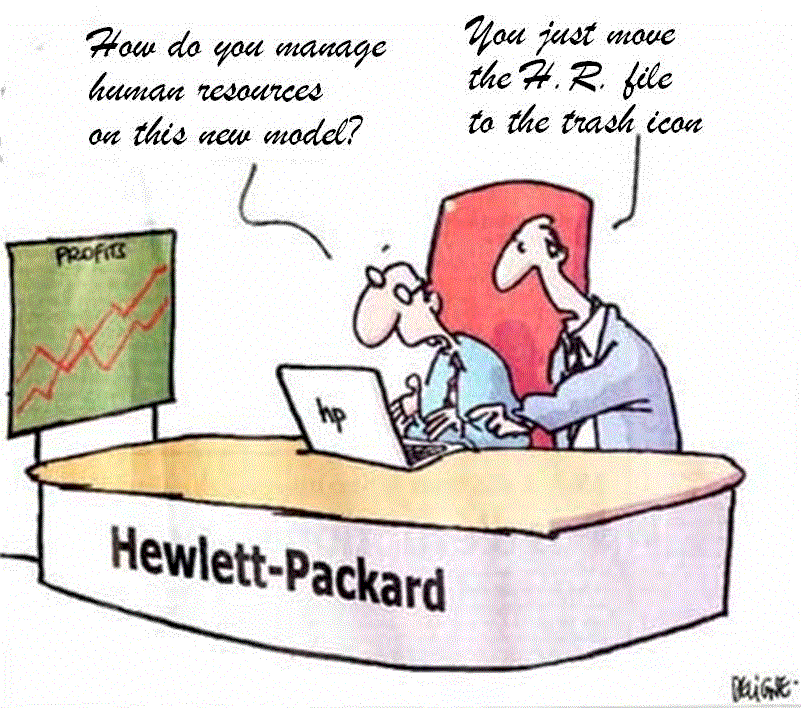
The HP chief executive officer has already seen the company through a huge restructuring that reduced headcount by more than 15,000 and overhauled its retirement plan. And at a meeting with analysts in New York on Dec. 12, Hurd made it clear that there is still more work to be done.

"We are a company transforming, not a company transformed," Hurd said more than once during his remarks. And it's clear there are many targets he has in mind. Real estate is one—HP has "too much" of it, according to Hurd. Operational and information technology costs are too high, he said. "We still have a lot of heavy lifting to do."

Take IT costs. Analyst Lou Miscioscia of Cowen & Co. in New York estimates that HP spends 4% of sales on IT infrastructure. "That's high compared to other companies who spend about 2% to 3%. If they cut it down to those levels, that could mean $900 million in savings," he says.
But as any first-year MBA student knows, cutting costs doesn't translate into increasing revenue. Hurd says that calls for flooding the zone with a batch of new sales personnel. Hurd wouldn't say exactly how many the company has hired or will recruit, saying only that so far "hundreds" have been brought in, and that their results are being tracked closely. "We track sales by person, not only to see how much they're selling but what else they have in their funnel," Hurd said.

So between cutting costs and boosting sales personnel, is that enough for HP ? Not to American Technology Research analyst Shaw Wu, who says he's keeping his neutral rating on the stock for now. "Everything they said is pretty much in line with expectations," Wu says. "We expected more cost-cutting and more attention to sales. But at some point HP needs to reinvest and build up some new revenue streams. Until then it's going to be mostly a cost-cutting story."

Clearly, there is progress being made. The operating margin range expected for 2008 is way ahead of the 6% range HP turned in for 2005. And that leaves the picture looking anything but dour at HP for the next eight quarters or so. "Hurd is a master of setting attractive expectations and then overdelivering on them," says Cowen's Miscioscia. "Even just hitting those expectations, the picture is pretty attractive."

vendredi 8 décembre 2006

HP to pay to settle pretexting lawsuit but shareholder suit alleges insider trading


HP agreed yesterday to pay $14.5 million to settle a lawsuit brought by state Attorney General Bill Lockyer accusing the company of unfair business practices in its crusade to unmask the source of boardroom leaks to the news media.

The vast majority of the settlement -- $13.5 million -- will fund state and local investigations into privacy rights and intellectual property violations, according to the lawsuit and settlement filed simultaneously in Santa Clara County Superior Court.

"Fortunately, Hewlett-Packard is not Enron," Lockyer said. "I commend the firm for cooperating instead of stonewalling, for taking instead of shirking responsibility, and for working with my office to expeditiously craft a creative resolution."
The state likely would have recovered far less if the case were taken to court, based on the limited penalties it could claim for each phone number that was illegally accessed during the leak probe, Lockyer said in an interview with The Associated Press.

"It's a good example of the HP that we all grew up with, the old HP of Hewlett and Packard, the ethics and principles of corporate responsibility and good management practices," he said. "We see those re-emerging in the way they dealt with this matter."

The remainder of the settlement amount consists of $650,000 in civil penalties and $350,000 to cover the state's investigation and other costs. HP has also agreed to various governance reforms to be in place for five years, which Lockyer said will help protect privacy rights during any future HP investigations. Some of those reforms include the appointment of an independent director to monitor HP's compliance with privacy guidelines, and additional training for investigative staff.

HP CEO Mark Hurd said in a statement that the company is "committed to ensuring that HP regains its standing as a global leader in corporate ethics and responsibility." The agreement did not include a finding of liability against HP. Prosecutors said the company hired outside detectives who tricked phone companies into disclosing the private phone records of directors, journalists and others so the company could track the source of news leaks.

Revelations of the probe, disclosed in a regulatory filing, led to an exodus from the board, criminal charges, a congressional investigation, and ongoing federal probes by the FBI, the Securities and Exchange Commission, federal prosecutors and other agencies. Dunn, who was ousted over the incident, former ethics chief Kevin Hunsaker and three outside investigators, Ronald DeLia, Matthew DePante and Bryan Wagner, have pleaded not guilty in Santa Clara County Superior Court to charges of identity theft and fraud for their roles.
The company's stock price has been relatively unaffected by the scandal, buoyed by strong earnings growth under CEO Mark Hurd and the belief that the turmoil had little affect on operations.

HP shares have actually gained around 9 percent since the probe was disclosed in a regulatory filing, but fell 28 cents to $39.86 Thursday on the New York Stock Exchange. News of the settlement was reported late Wednesday by CNet Networks Inc.'s News.com.
Details of the agreement were announced after the market closed, and HP shares gained a penny.

Analysts said the penalty was relatively minor and would go a long way toward assuaging fears among skittish investors. "It looks like they got off pretty easy, and that this is actually going to be a good thing for HP," said Roger Kay, who follows the company as president of market research firm Endpoint Technologies Associates. "It looks like they're in control of their destiny and have put at least some of this behind them."

But another lawsuit alleges that Chief Executive Mark Hurd and other directors and senior executives sold about $41.3 million of HP stock in the two-and-a-half weeks preceding HP's disclosure that investigators working on its behalf used false pretenses to obtain directors' and journalists' private phone records.

This lawsuit alleges the board approved stock buybacks totaling $10 billion in the months leading up to the scandal "to keep the company's stock price propped up while insiders were selling." The board knew its leak investigation was likely to be made public when it approved a $6-billion repurchase on Aug. 21, the suit alleges.

"Pattie Dunn is not accused of insider trading," Brosnahan said in a statement. Dunn "has never sold any of her Hewlett-Packard stock". The lawsuit alleges that sales by HP insiders surged in the third quarter, when the leak investigation was disclosed, from previous quarters. Hurd, who replaced Dunn as chairman, sold 125,000 HP shares for about $4.38 million from April 3 through Aug. 25, according to the lawsuit filed on behalf of investors, including a union pension fund.

The investors, represented by law firm Lerach Coughlin Stoia Geller Rudman & Robbins LLP, claim the defendants sold shares because they knew "the market's perception of HP would be significantly damaged when (not if) the market became aware of the full extent of distrust and acrimony among board members, the outlandish smear campaign tactics the acrimony had spurned and the illegality of the investigatory tactics being used."

mercredi 29 novembre 2006

CPB is over. Here is the IPB.

Mark Hurd is now considering more than two CPBs moving forward. Not only Business Unit CPBs and sub-Business Unit CPBs but workgroup CPBs !

So the name COMPANY Perfomance Bonus doesn't make sense anymore. We kindly suggest the use of IPB (Individual Performance Bonus) as a better acronym. Just one more individual reward at HP, we were short of...

HP one company ? Forget about it !
Teamwork at HP ? ...

"Tough Cultural Message" Mark Hurd said : you bet !

dimanche 19 novembre 2006

2 CPB, 2 Issues...

It was great to get a FY06 bonus while HP is multiplying profit by 4, but...

1/ HPS employees are furious to get 4.83% when all the others enjoy 9.47%

2/ Non HPS employees should have been happy to get more than one month of salary, but they don't fully enjoy it because of point 1...

Nobody noticed that HPS and non HPS employees are all working together...

"Importance of building trust" matters to Wall Street and customers. To employees also !

samedi 18 novembre 2006

The SEC development is a dark cloud over HP's sunny financial news

The SEC development was a dark cloud over HP's sunny financial news.

HP said in a regulatory filing that the SEC had upgraded its informal inquiry into the spying scandal into a formal investigation.

The Federal Communications Commission has also requested documents related to HP's effort to unmask the source of boardroom leaks to the media, and HP faces five shareholder lawsuits related to the investigation, according to the filing.

HP had previously disclosed that it was the subject of inquiries by the SEC, the U.S. Attorney's Office for the Northern District of California, a congressional panel and California's attorney.

jeudi 9 novembre 2006

Five years on: HP Compaq merger declared a success


IDC believes the deal has achieved its main objectives :

"This deal enabled the merged company to grow revenue and profits in an increasingly competitive marketplace." "The merger accomplished what HP and Compaq set out to do in the first place, providing the critical mass and reach needed to ensure a long-term role in an industry undergoing a fundamental transition," said Jean S. Bozman, research vice president in IDC's Worldwide Server group and co-author of the report.

But IDC warned that organisational changes have remained a "critical issue" as HP had reduced the size of its workforce, seen the departure of two chief executives, and reorganised its management structure. However, it was not just technological change that facilitated the merger. IDC maintained that the commitment to cultural change was equally important, where it was hoped that the infusion of Compaq's fast-paced corporate culture would help increase HP's "business velocity".

OpenView gave HP a foundation from which to build in the software business, putting the company in a stronger position to compete with the largest system and services providers worldwide, the analyst firm noted. According to IDC, an important linchpin to the merger's success was the commitment to infrastructure software, which helped move the combined company away from commodity hardware and into the management layer.

"By completing the deal when it did, HP managed to position itself for the next wave of enterprise computing by leaping ahead of the trends that were working against the two companies as independent entities." "The merger came at a time when both companies were becoming irrelevant in a number of key product categories. "What makes the merger interesting from a technology perspective is the extent to which HP has improved its position in a number of core markets that were rapidly commoditising," said Crawford Del Prete, senior vice president of communications, hardware, services and software research at IDC.

IDC has now claimed that the firms have successfully completed a "massive integration effort" and moved the combined company forward to new revenue and profit levels. The analyst firm said at the time of the merger, which was first mooted in September 2001, that the two companies would be "better off together".

Five years after the mega-merger that saw Compaq climb into bed with HP, IDC has declared the deal a success.

samedi 4 novembre 2006

Executive Carnage at HP ?

Five general managers lost in the last two weeks !

- Steve Smith, the head of HP's revenue-flat $15.5 billion services business, has unexpectedly resigned, citing personal reasons.

- The head of HP's billion-dollar OpenView business, Todd DeLaughter, has quit to become CEO of Opalis, the Canadian software company.

- HP's channel chief John Thompson has left and Rick Becker, the head of its blade operation, which has been waging hand-to-hand combat with IBM, has been poached by Dell, presumably at the behest of his old boss Brad Anderson, who went to Dell last year as senior VP of its product group. Becker was also CTO of HP's x86 servers. Anderson used to run HP's industry standard servers Smith, DeLaughter and Becker all worked for Ann Livermore, the head of HP's $33 billion technology solutions group, who will temporarily replace Smith until the company comes up with a new body.

- HP had also lost the GM of its Business Critical Systems unit Rich Marcello. He has quit to work for non profit organisations.